
Most people start thinking about the TEF the same way. A Canada immigration plan is taking shape; someone mentions that French can add points, and suddenly there is a test date to worry about. The exam itself is not impossible. What catches people out is preparing without a plan: a bit of grammar one week, a few videos the next, and no idea whether the effort is adding up.
This guide gives clarity about the work. It covers the four sections of time management and weekly schedule.
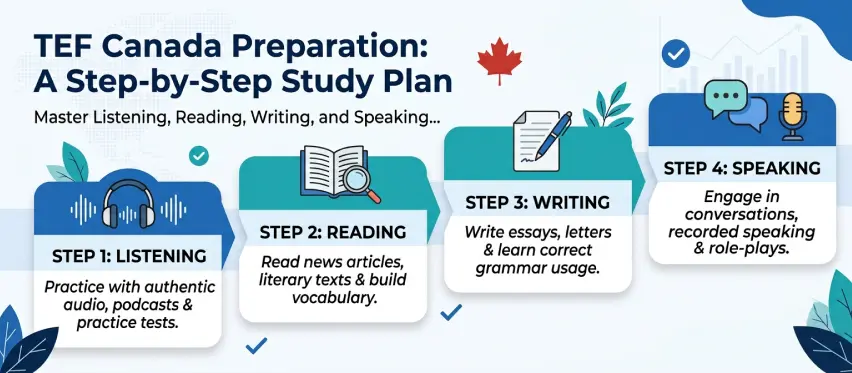
What Is the TEF Exam? Format, Sections & Scoring
TEF is a French proficiency test accepted for Canadian immigration and citizenship applications. It has four parts, and each is scored separately:
- Listening (compréhension orale): about 40 minutes, with audio played once
- Reading (compréhension écrite): about 60 minutes of questions on texts of varying difficulty
- Writing (expression écrite): 60 minutes, split into two tasks
- Speaking (expression orale): about 15 minutes, also in two tasks
Your results are converted to Canadian Language Benchmark levels, also known as immigration programs. Before you set a target, check what score your own application needs. A person aiming for the minimum needs a different plan from someone chasing the highest points.
Step 1: Take a Practice Test to Find Your French Level
Do not begin by studying. Begin by testing yourself. Take a full practice paper under timed conditions, then note which section hurts most. Many learners are surprised. Someone who reads French comfortably focuses on the listening section because the audio plays only once at the normal speed.
Write down your rough level in each skill. It is a baseline for every few weeks. Without a baseline, progress feels like guesswork.
Step 2: Strengthen Your French Basics (Weeks 1-3)
If your general French is still shaky, spend the first three weeks on basics before you touch exam strategy. Fix your present, past, and future tenses, learn the common connectors (cependant, par ailleurs, en revanche), and build a daily vocabulary habit of ten new words with example sentences.
Learners who join classes for French with a structured level system for the learning process usually move through this stage faster because a trainer catches the habitual errors you cannot hear in your own speech. Record yourself and compare with native audio.
Do not skip this level to "save time." The exam rewards solid everyday French far more than clever tricks.
Step 3: Listening Practice (Weeks 3 to 6)
Listening is the section where most candidates lose marks, mainly because it is the hardest to practice in isolation. Some ways to improve:
- Listen daily, even for ten minutes: News bulletins, interviews, and radio clips from Canadian sources are ideal, since the accents in the exam are Canadian and French.
- Use the three-pass method: First listen without any text. Then listen again while noting keywords. Finally, check the transcript and mark every word you missed.
- Train yourself to listen once: In the exam, the audio does not repeat, so practice with clips; you play only one time.
- Predict before you listen: Read the question first and guess what kind of answer you need: a number, a time, a reason, or an opinion.
Keep a notebook of words you misheard. Patterns appear quickly, and they are usually the same few sounds causing trouble.
Step 4: Reading Practice (Weeks 4 to 7)
Reading looks easier than it is because the time pressure is real. You have a lot of texts and not much time per question.
Start by reading short French paragraphs daily without a dictionary. Underline words you are not able to read, but finish the passage before you look anything up. Your brain needs practice guessing meaning from context, because that is exactly what you will do in the exam.
Step 5: Writing Practice (Weeks 6 to 10)
The writing section has two tasks. The first usually asks you to continue or respond to a short piece of text, and the second asks you to give an opinion in a more formal piece of writing. It has word targets, and they are marked on structure, vocabulary, and grammar.
A simple weekly routine works well:
- Write one full task under timed conditions.
- Wait a day, then reread it and mark errors yourself first.
- Ask a trainer or fluent friend for feedback, or compare your text with a model answer.
- Rewrite the weakest paragraph.
Build a small toolkit of useful phrases for opening, giving a reason, offering a counterpoint, and concluding. You are not memorising a script. You are making sure that under pressure you have clean, correct ways to organize your thoughts and count your words as you practice.
Step 6: Speaking Practice (Weeks 6 to 11)
Speaking is the section learners fear most, and it is also the one that improves fastest with regular practice. In one task you typically ask questions to gather information; in the other you argue a point and try to persuade someone.
What helps most:
- Speak aloud every single day: Even five minutes of describing your day or giving an opinion on a news topic builds fluency.
- Practice asking questions: The learners can answer, but some learners struggle to form questions quickly and correctly
- Learn persuasion language: Phrases like "à mon avis," "il faut absolument," and "vous devriez" give your speech shape.
- Do mock interviews: Ask a trainer or partner to play the examiner, and record the session.
Do not worry about fluency like a native speaker. Clear pronunciation, steady pace, and well-organized ideas count for more than accent.
Step 7: Full Mock Exams (Weeks 10 to 12)
In the last three weeks, switch to full-length practice. Sit all four sections in one go, in a quiet space, with a timer. This builds stamina, which is a real factor on test day.
After each mock, review properly. For every mistake, ask whether it was a vocabulary gap, a grammar error, a timing problem, or a misread question. Keep a short list of your top three recurring errors and work on them before the next mock.
If you are enrolled in a TEF Canada preparation course, use the mock exams it offers and ask for detailed feedback rather than just a score. A number tells you where you stand; comments tell you what to fix.
Weekly Study Schedule (10 Hours a Week)
You will adjust this for work or study, but here is a realistic outline for someone with about ten hours a week:
- Monday: Grammar and vocabulary, 90 minutes
- Tuesday: Listening, 90 minutes
- Wednesday: Reading, 90 minutes
- Thursday: Writing task and self-review, 2 hours
- Friday: Speaking practice with a partner or trainer, 90 minutes
- Saturday: Timed mixed practice, 2 hours
- Sunday: Rest, with light listening only
Short daily contact with the language matters more than one long weekend session.
How to Choose the Best French Classes
You can prepare alone, but most successful candidates have some guidance, especially for writing and speaking, where you cannot judge your own mistakes easily. When comparing options for TEF Canada preparation, look for small batches, regular speaking time, individual feedback on written tasks, and honest mock exams.
For anyone building their French language skills from the beginning, it also helps to find a provider that handles general learning and exam work together, so you do not have to switch teachers halfway. People who are serious about French learning in Chennai often find that a local trainer who understands common mistakes among Tamil and English speakers can save weeks of confusion. Good French language training in Chennai should also include a level assessment at the start, so you know your baseline before you spend money on a course.
6 Common Mistakes to Avoid
- Practicing only your strongest section because it feels good
- Leaving speaking practice until the final fortnight
- Memorising model essays instead of learning flexible structures
- Ignoring timing during practice
- Studying in long, irregular bursts rather than daily sessions
- Booking the exam before you have scored consistently in mocks
Test Day Tips: What to Do Before and During the Exam
Sleep properly the night before. Reach the centre early, carry the right ID, and do not try to learn anything new that morning. During the exam, read instructions carefully, pace yourself, and keep moving when you are stuck. In the speaking section, stay calm and speak at a steady speed, because rushing causes more errors than a slightly slower pace ever will.
Ready to Start? Your TEF Preparation Checklist
Preparing for the TEF is mostly a matter of order and consistency. Find your baseline, fix your foundation, give each skill its own focused weeks, and finish with timed mocks. Nothing here is complicated, but it does need regular effort over a few months, not a last-minute rush.
If you want expert guidance while you work through this plan, look for French classes in Chennai at an academy like Fluent French Academy, which offers exam-focused batches, regular speaking practice, and personal feedback on your writing. Pair that support with daily practice of your own, and you will walk into the test centre knowing exactly what to expect.
