
You open the result email, see a page of numbers, and have no idea whether they are good. We hear this from students almost every month. Someone scores 262 in reading and wonders if that is high. Someone else clears DELF B1 with 52 out of 100 and isn't sure it counts as a "proper" pass.
Both exams test how well you can actually use the French language, but they report results in very different ways. Once you know how to read them, the numbers stop being scary. If you are aiming for Canada, TEF Canada is probably on your list. If you want a certificate that never expires, or a place at a French university, DELF is more likely. This guide explains both, in plain words.
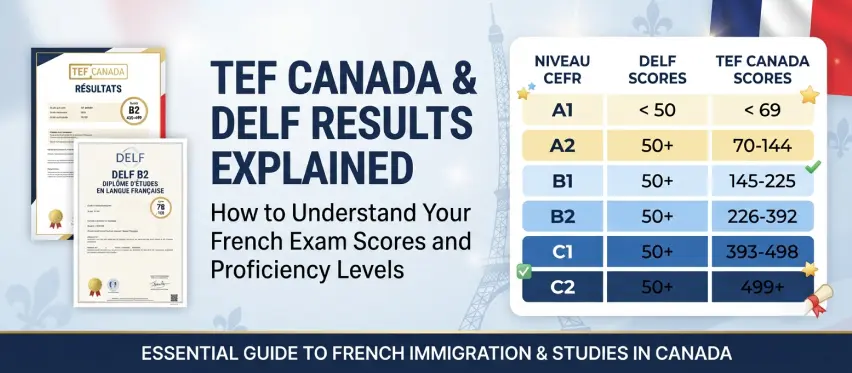
How Do TEF and DELF Results Work?
TEF Canada gives you a score for each of four skills (listening, reading, writing, speaking). Each score maps to an NCLC level from 1 to 12, which is what Canadian immigration authorities look at.
DELF gives you a mark out of 100 for one CEFR level (A1, A2, B1 or B2). You need 50/100 overall and at least 5/25 in each skill to pass.
TEF Canada results are valid for two years. A DELF diploma is valid for life.
How Is the TEF Scored? Marks for Each Skill
TEF Canada is run by the Paris Chamber of Commerce and Industry (CCI Paris Île-de-France) and is accepted by IRCC for Express Entry and other Canadian immigration and citizenship routes. It has four compulsory tests, and you get a separate score for each one:
| Skill | French name | Maximum score |
|---|---|---|
| Listening | Compréhension orale (CO) | 360 |
| Reading | Compréhension écrite (CE) | 300 |
| Writing | Expression écrite (EE) | 450 |
| Speaking | Expression orale (EO) | 450 |
The maximum total is 1,500, but nobody uses the total. Immigration authorities convert each skill separately into an NCLC level (Niveaux de compétence linguistique canadiens). This matters because one weak skill can hold back your whole profile, even if the other three are excellent.
TEF Score to NCLC Level Chart: What Your Numbers Convert To
The conversion is not a straight percentage. Each skill has its own score band. Here are the minimum scores for two commonly needed levels:
| Skill | NCLC 5 (from) | NCLC 7 (from) |
|---|---|---|
| Listening | 181 | 249 |
| Reading | 151 | 207 |
| Writing | 226 | 310 |
| Speaking | 226 | 310 |
NCLC 7 is the benchmark many Express Entry applicants aim for, since it is the minimum for several federal skilled streams. NCLC 7 sits roughly at CEFR B2, while NCLC 5 is close to B1. Higher levels earn you more points in the Comprehensive Ranking System, so every band you move up can matter.
A small warning: IRCC updates its tables from time to time. Before you plan an application around a particular number, check the current conversion chart on the official IRCC website.
What Do NCLC Levels Mean in Real-Life French?
Think of NCLC as a description of what you can do with French in real life:
- NCLC 4–5: You manage everyday situations, such as simple emails, short conversations and routine forms, but you still hesitate and make frequent errors.
- NCLC 6–7: You follow most conversations, write clear work-related messages, and explain your views with reasonable accuracy. This is the working-level zone
- NCLC 8–9: You handle detailed discussions, understand fast speech and write structured, well-argued texts
- NCLC 10 and above: ou use French almost as comfortably as an educated native speaker
So when you see 249 in listening, don't think "that is only 69% of 360." Think "that is NCLC 7, which means I can follow most real-life conversations."
How Is DELF Scored? Pass Marks and Minimum Skill Scores
DELF (Diplôme d'études en langue française) is issued by France Éducation international on behalf of the French Ministry of Education. Unlike TEF, you don't sit a test that tells you your level. You choose a level first (A1, A2, B1 or B2) and then try to pass that specific diploma.
Each exam has four parts, and each part is marked out of 25:
- Listening comprehension (compréhension de l'oral)
- Reading comprehension (compréhension des écrits)
- Written production (production écrite)
- Oral production (production orale)
That adds up to 100. To pass, you need at least 50/100 and a minimum of 5/25 in every skill. This second rule catches people out. A candidate who scores 90 in three skills but 4 in speaking will not receive the diploma.
There is no "fail with a grade." You either pass the level or you don't. Results usually arrive within a few weeks, and the diploma never needs renewing. If you pass B1, for example, you can later attempt B2 without redoing anything.
DELF vs TEF Canada: Which Result Does Your Goal Need?
| TEF Canada | DELF | |
|---|---|---|
| Result format | Score per skill, converted to NCLC | Total out of 100, pass or fail |
| Level reporting | You are placed on a scale | You attempt a fixed level |
| Validity | 2 years | Lifetime |
| Best for | Canadian immigration and citizenship | Study in France, jobs, personal goals |
A common confusion is thinking a DELF B2 automatically satisfies Canadian immigration. It doesn't. Canada requires specific tests, and TEF Canada is one of them. If your goal is Canada, check which exam is accepted for your stream before you book anything.
5 Mistakes to Avoid When Reading Your French Exam Results
- Looking only at the total: For TEF, the total means very little. The lowest-scoring skill usually decides your NCLC profile
- Ignoring the 5/25 rule in DELF: A strong overall mark doesn't help if one skill falls below the minimum
- Comparing scores across exams: A TEF score of 300 in reading and a DELF mark of 20/25 are not the same thing. Convert to CEFR or NCLC before comparing.
- Taking the exam too early: Many students book a test after three months of casual study and then feel disappointed. B2 usually needs far more guided practice than people expect
- Forgetting the expiry date: If your TEF result will expire before your application is ready, you may have to sit the test again
How to Improve a Low French Exam Score
In our experience, the skill that drags people down is rarely the one they worry about. Most students fear grammar, but it is often listening speed or timed writing that costs them marks.
Here is what works:
- Review your score report by skill: Find the one skill that is furthest from your target NCLC or DELF level, and give it the most weekly practice time
- Practise under real exam timing: Writing a good letter in 60 minutes is a different skill from writing one with no clock
- Speak out loud every day: Ten minutes of recorded speaking, played back and corrected, improves fluency faster than silent revision
- Listen to varied French: Radio, podcasts, news clips and regional accents help you cope with the real audio you'll hear in the exam
- Get feedback from a trainer: Writing and speaking need a second pair of ears. You can't mark your own mistakes if you don't know they are mistakes
This is where structured TEF Canada preparation makes the biggest difference. A good plan tells you which task types appear, how examiners score them, and where candidates usually lose points. If you want that kind of guided support, a dedicated TEF Canada preparation course with mock tests and speaking practice is far more efficient than studying alone. Many of our learners also begin with regular classes for French to build a strong B1 base before they move into exam-focused training.
Turn Your French Exam Score Into a Study Plan
Exam results are not a verdict on you. They are a map. TEF Canada tells you exactly where each skill stands on the NCLC scale, and DELF tells you whether you have cleared a specific CEFR level. Once you understand that, you can stop worrying about the raw numbers and start planning the next step.
If you're looking for French classes in Chennai that focus on real results, our trainers at Fluent French Academy can help you read your score reports, find your weak spots and build a realistic study plan. Whether you need French language training in Chennai for immigration, higher studies or a career move, or you simply want a friendly place for French learning in Chennai, we're here to guide you at every level.
