
Many learners can order a coffee in French and still go quiet when a colleague asks about a deadline. Everyday French and workplace French overlap, but they are not the same thing. At work, tone matters, politeness has rules, and a few wrong words can make an email sound rude or confusing.
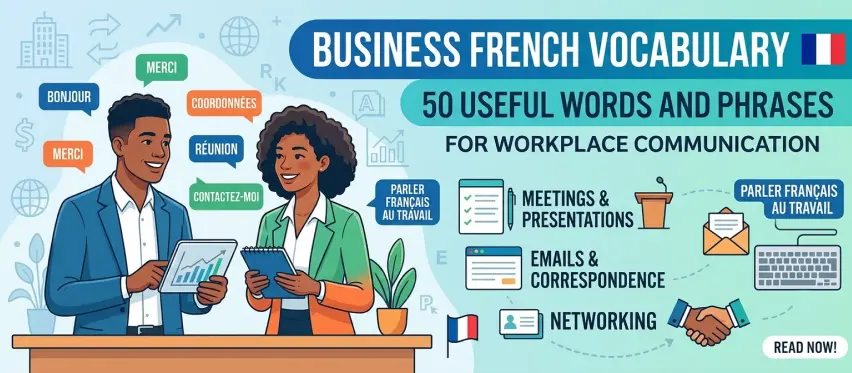
This guide collects 50 words and phrases that come up again and again in offices, meetings, calls, and emails. Think of business French vocabulary. You do not need to memorize all 50 at once. Pick one section, use it this week, then move on to the next.
Why You Need Business French Vocabulary for the Workplace
If you are learning French for work, you will notice that formal French is quite different from casual French in apps and films. Colleagues who speak to each other as "tu" will still write to clients as "vous." Emails open and close with fixed, polite formulas. Meetings have their own vocabulary too, such as “l’ordre du jour” (agenda), “le compte rendu” (minutes), and “une échéance” (deadline).
The good news is that these phrases are repetitive. Once you know twenty or thirty of them, you can follow most routine office exchanges.
Tu or Vous in Business French: Which Should You Use at Work?
Use vous with clients, senior colleagues, and anyone you do not know well. Switch to tu only when the other person invites you to, or when the whole office clearly does. If you are unsure, stay with vous.” Being too polite is rarely a problem, and nobody will be offended by it.
Business French Greetings and Introductions
First impressions count, and these phrases make them smooth.
- 1. Enchante(e): Pleased to meet you
- 2. Je me présente: Let me introduce myself to you
- 3. Comment allez-vous?: How are you? (formal)
- 4. Je travaille chez…: I work at…
- 5. Voici ma carte de visite: Here is my business card
- 6. Je vous en prie: You are welcome / Please, go ahead
- 7. Merci de votre accueil: Thank you for your words
- 8. Je vous souhaite la bienvenue: I welcome you
Add "enchanté" if you are a man and "enchantée" if you are a woman. The sound is the same, but the spelling changes.
Key Phrases for Business Meetings
Meetings feel the most pressure on learners, so these are worth practicing aloud.
- 9. Une réunion: A meeting
- 10. L'ordre du jour: The agenda
- 11. Le compte rendu: The minutes
- 12. Un rendez-vous: An appointment
- 13. Reporter: To postpone
- 14. Annuler: To cancel
- 15. Une échéance: A deadline
- 16. Je suis d'accord: I agree
- 17. Je ne suis pas tout à fait d'accord: I don't quite agree
- 18. Pourriez-vous répéter, s'il vous plaît?: Could you repeat that, please?
Number 17 is a very useful softener. French business culture values polite disagreement, and "pas tout à fait" sounds far more professional than a flat "non."
French Business Email Phrases:
Written French at work follows patterns, and following them makes you look careful and competent.
- 19. Madame, Monsieur: Dear Sir or Madam,
- 20. Je vous écris au sujet de… : I am writing to you about…
- 21. Suite à notre conversation… : Following our conversation…
- 22. Veuillez trouver ci-joint… : Please find attached…
- 23. Une pièce jointe: An attachment
- 24. Je reste à votre disposition: I remain at your disposal
- 25. Dans l'attente de votre réponse: Looking forward to your reply
- 26. Cordialement: Kind regards
- 27. Veuillez agréer, Madame, Monsieur, mes salutations distinguées: yours faithfully (very formal)
- 28. Je me permets de vous relancer: I am following up/sending a reminder
Phrase 27 is long, and you will not use it in every email. It belongs in formal letters or first contact with senior people. For everyday messages, "Cordialement" is enough.
French Phone Phrases for the Workplace
French Phone Phrases are harder because you cannot see the other person's face. A few fixed phrases help a lot.
- 29. Allô: Hello
- 30. C’est de la part de qui? : Who may I say is calling?
- 31. Ne quittez pas: Please hold
- 32. Je vous passe M. Dupont: I'll put you through to Mr. Dupont
- 33. Puis-je laisser un message? : Can I leave a message?
- 34. Pouvez-vous épeler votre nom? : Can you spell your name?
Learning the French alphabet properly is worthwhile here, because names and email addresses are spelled out on almost every call.
French Workplace Vocabulary: People, Documents and Workplace Nouns
These are the nouns you will hear daily.
- 35. Un collègue / une collègue: A colleague
- 36. Un responsable: A manager
- 37. Unclient: A client
- 38. Un fournisseur: A supplier
- 39. Un contrat: A contract
- 40. Une facture: An invoice
- 41. Un devis: A quotation
- 42. A budget: A budget
- 43. Un bureau: An office or desk
- 44. Une entreprise: A company
Most of these are easy to remember because they resemble English words. The tricky one is "un devis." Many learners confuse it with an invoice, but a devis is the price estimate you receive before work begins.
French Vocabulary for Deadlines, Delivery and Price Negotiation
The group covers the practical talk of delivery and price.
- 45. Quel est votre meilleur prix? : What is your best price?
- 46. Une remise: A discount
- 47. Un délai: A client
- 48. Livrer: To deliver
- 49. Nous avons du retard: We are running behind schedule
- 50. Je vous tiens au courant: I'll keep you posted
"Je vous tiens au courant" is a small gem. It sounds natural and like something is still in progress.
Who Should Learn Business French Phrases?
A list like this helps several kinds of learners. Anyone looking at French for professionals will find it useful, including people who work with French clients or suppliers, staff of multinational companies, and employees who may be posted abroad. Job seekers can also use it, since even a basic level of professional French on a CV can set you apart in some sectors.
Students preparing for exams such as the DELF Pro or TEF also benefit, because workplace vocabulary appears often in their reading and speaking tasks.
How to Remember Business French Vocabulary: 6 Simple Habits
A list is only the start. These simple habits turn the list into a skill you can use at work:
- Learn in clusters, not in order: Choose one scenario, such as a phone call, and master those six phrases before the next group.
- Write your own sentences: For example, “Je vous rappelle demain” (I will call you back tomorrow) is easier to remember when it matches something you actually plan to do this week.
- Role-play with a partner: One person plays the client and the other the supplier. Swap halfway.
- Record your voice: Listening back helps you spot pronunciation problems, especially with nasal sounds like “en” and “on.”
- Used in emails: Rewrite an email you sent in English, this time in French, using the phrases from the email section.
- Revisit after a week: Repeating a phrase seven days later helps it stay longer than reading it five times today.
Common Business French Mistakes and How to Avoid Them
Some errors show up so often that they are worth naming:
- Using “tu” with clients or managers before they invite you to
- Translating English emails word for word, which produces stiff or odd French
- Forgetting gender, for example, saying "un facture" instead of "une facture"
- Ending emails with "Bye" or "Merci beaucoup" and nothing else, when a proper closing is expected
- Avoiding phone calls and relying only on email, so your listening skills never improve
Mistakes are normal, and colleagues usually appreciate the effort. Still, a little structure early on prevents bad habits from setting in.
Business French Training in Chennai: What to Look For
Self-study works for vocabulary, but speaking and email writing improve faster with feedback. Someone who is serious about French learning in Chennai should look for a program that includes workplace scenarios, not only textbook grammar. Likewise, French language training in Chennai that offers level tests, small batches, and speaking practice gives you a clearer path from basic phrases to confident office conversation.
Ask any provider whether the course covers emails, phone calls, and meeting language, since these three account for most daily communication at work.
Start Learning Business French Today: Your Next Steps
You do not need perfect grammar to work in French. You need a dependable set of phrases, a polite tone, and the confidence to use them. The fifty expressions above cover the situations you are most likely to meet, from your first introduction to a follow-up on a late delivery. Learn them in small groups, practice them aloud, and apply them to real tasks as soon as you can.
If you want expert guidance while you work through this plan, join Fluent French Academy, one of the trusted French classes in Chennai offering exam-focused batches, regular speaking practice, and personal feedback on your writing.
